A short disclosure before anything else: this is not written by a doctor, and no clinician reviewed it. What follows is built from primary sources you can check yourself, the FDA-approved Vyleesi prescribing information [3], the 2019 FDA approval letter [2], the RECONNECT Phase 3 trial published in Obstetrics and Gynecology [1], and the NIH LiverTox monograph [4]. On the anti-doping question, the approach here is narrower and more careful, because overstating certainty on that point could genuinely cost someone their season.
For a tested athlete considering PT-141 for libido or sexual function, the calculation is different than it is for anyone else. A positive test carries consequences a general consumer never faces. So this piece is organized around a simple question: at what level of evidence does each claim about PT-141 actually sit? Some of what gets said about it is FDA-documented fact. Some is a modest, real finding from a controlled trial. And some is marketing dressed up to sound more settled than it is. Knowing which is which matters more here than almost anywhere else in the supplement and peptide market.
Tier one: what is actually approved, and for whom
PT-141 is the peptide bremelanotide, and it circulates in gym and athlete circles on the strength of one phrase: “it’s FDA-approved.” That phrase is doing more work than it should.
Bremelanotide is approved, under the brand name Vyleesi, for one specific population: premenopausal women with acquired, generalized hypoactive sexual desire disorder. The label is explicit that it is not indicated for men, not for postmenopausal women, and not for enhancing sexual performance [3]. Read that again against what’s being marketed to athletes. The exact use, performance-oriented, in men, is precisely the use the approval does not cover. And the compounded or research-grade product an athlete would actually purchase isn’t the approved finished product at all. It’s a different supply chain wearing the approval’s credibility.
This is tier one because it isn’t debatable. It’s what the FDA’s own paperwork says, plainly.
Tier two: a real but modest finding, in a population that isn’t athletes
The clinical evidence behind Vyleesi is the RECONNECT program, two randomized, double-blind, placebo-controlled Phase 3 trials covering roughly 1,267 premenopausal women with HSDD. Bremelanotide outperformed placebo on desire and on distress, and the difference reached statistical significance [1]. That’s a genuine finding, not nothing.
But “statistically significant” and “life-changing” are not synonyms, and the size of the effect matters. The improvement was around 0.35 on the desire score and a 0.33 reduction in distress [1]. That’s a real, measurable, moderate benefit, in women, for a specific diagnosed disorder. It says nothing about men, nothing about athletic performance, and nothing about the “edge” being marketed in gyms. Whatever an athlete hopes to get from PT-141 sits entirely outside the data that earned it approval. Off-label isn’t automatically wrong, but it is, by definition, unproven for that use.
The side-effect profile deserves equal weight here, because the marketing rarely mentions it. Straight from the FDA label: nausea affected 40% of patients, common enough to be the leading complaint, with 13% needing anti-emetic medication and 8% discontinuing the drug entirely. Flushing occurred in roughly 20%. And this next one should matter to anyone training seriously: bremelanotide transiently raises blood pressure and lowers heart rate after each dose, with single-dose maximal increases around 6 mmHg systolic and 3 mmHg diastolic, typically resolving within about 12 hours [3]. That’s precisely why it’s contraindicated in uncontrolled hypertension and known cardiovascular disease. Athletes who train hard but have never had a proper cardiovascular workup are not a trivial subgroup here.
There’s also a cosmetic effect tied to the drug’s mechanism. Because bremelanotide acts on the MC1R receptor involved in pigmentation, it can cause focal hyperpigmentation, darkened patches of skin, including on the face. At the labeled intermittent dosing, roughly 1% of women developed it. With eight days of daily dosing, that figure rose to 38%, with higher risk in people with darker skin, and it did not always resolve after stopping [3]. Self-dosing a vial aggressively, without a clinician’s guidance, is exactly the pattern that produces this outcome.
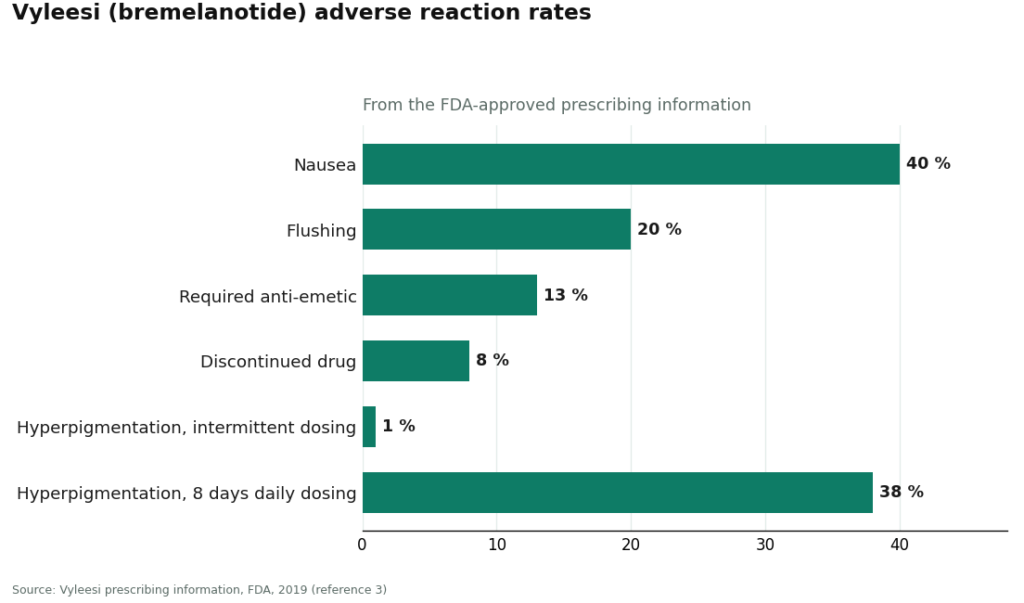
The honest summary of tier two: a modest, real effect in women with a diagnosed disorder, paired with a side-effect ledger, nausea, blood pressure changes, skin pigmentation, that the athlete-facing marketing quietly leaves out.
Tier three: the anti-doping status, stated with the uncertainty it actually has
This is the section where it would be easy to either overstate the danger or wave it away, and neither is honest.
Here’s what can be said with confidence. PT-141 isn’t testosterone, isn’t a SARM, and isn’t a stimulant, so it doesn’t fall into the categories athletes are already trained to scan for. But “not an obvious category” is not the same thing as “cleared.” The WADA Prohibited List includes a catch-all for pharmacological substances not currently approved by any governmental regulatory health authority for human therapeutic use, language built specifically to capture experimental and research-grade compounds circulating outside normal medical channels. Compounded, off-label PT-141 sits uncomfortably close to that description. And anti-doping enforcement runs on strict liability: what’s in your system is your responsibility, regardless of intent, regardless of whether the compound is named individually on the List.
What this piece will not do is claim bremelanotide is definitively listed by name on the current WADA Prohibited List. The List updates annually, and asserting a specific entry without direct verification would be exactly the kind of overreach this piece is trying to avoid. The responsible position is this: the status is genuinely uncertain-to-risky, the catch-all language is built to sweep in unapproved research compounds, and the only real answer is to check the current Prohibited List directly and clear it through your sport’s anti-doping body or a Therapeutic Use Exemption process before going near it. Absent a clear “this is permitted” from the organization that actually tests you, the sane default is to treat it as prohibited.
There’s a second layer of risk specific to how this compound is usually purchased. Buying from a research-chemical site means not actually knowing what’s in the vial. Even setting aside whether bremelanotide itself is a problem, an unverified product can be mislabeled or cross-contaminated with something unambiguously banned. Careers have ended over contaminated products the athlete never knowingly took. For someone who gets tested, an unverified vial isn’t just a purity gamble. It’s a doping-violation gamble layered on top.
If you proceed anyway, who treats this like medicine instead of a powder
Everything above points toward a default of “not without clearance.” But for readers who have checked the anti-doping question properly and have a legitimate medical reason to proceed, the sourcing question still matters enormously, because it’s the one variable actually under your control.
The safer end of this market is licensed telehealth, a real clinician plus a licensed pharmacy, not a research-chemical cart with a checkout button. Here’s how that tier breaks down.
FormBlends sits first, for reasons specific to the risks above. It’s a licensed telehealth provider rather than a chemical warehouse, which means two things an athlete should actually care about: a clinician who can screen for the blood-pressure contraindication before anything is dispensed, and a licensed pharmacy compounding verified bremelanotide rather than a “research use only” powder of unconfirmed contents. Supervised access runs roughly $90 to $250 a month. Verified sourcing directly reduces the contaminated-vial risk that turns into a doping violation, and a responsible provider should be upfront that Vyleesi is the FDA-approved product while compounded PT-141 is not, and that the performance use remains off-label. None of that resolves the anti-doping question. That part stays with the athlete and their sport’s governing body. Those using it under supervision can log doses and symptoms through the FormBlends tracker app, a tracking tool, not a prescription pad and not a storefront.
HealthRX (healthrx.com) holds the next spot, running the same model, clinician screening followed by dispensing through a licensed pharmacy, with the same honest caveat about Vyleesi’s approval scope versus compounded PT-141’s off-label status. Pricing sits in the same supervised range. For an athlete choosing between the two, the practical differences come down to state licensing and how each screening process fits, not any gap in safety standard.
MeriHealth takes third, applying the same physician-led model with an intake and clinical framework built around women’s health specifically. Clinician screening happens first, compounded peptide therapy goes through a licensed compounding pharmacy, and the same caveat applies: Vyleesi is approved, compounded versions are not, and neither resolves anti-doping status. For a female athlete with legitimate medical need and proper clearance, MeriHealth’s clinical focus on women’s health is the differentiator.
WomenRX rounds out the fourth spot, on the same supervised standard, real screening, licensed pharmacy sourcing, no gap between intake and dispensing, with a clinical orientation toward women’s health shaping how screening and follow-up are handled. As with the tiers above it, compounded medications here are not FDA-approved finished products, and no supervised provider answers the anti-doping question for you.
Below that line sits the research-chemical trade, and for a tested athlete this is the riskiest shelf in the market, pairing zero clinical screening with contents nobody has verified. Each of these ships PT-141 labeled “for research use only,” no clinician, no blood-pressure check, no prescription, no FDA oversight of what’s actually in the vial.
Sports Technology Labs sells SARMs alongside peptides under research-use labeling, and that SARMs adjacency is its own red flag, since SARMs are unambiguously prohibited, raising cross-contamination stakes considerably. Swiss Chems sells PT-141 next to other peptides and SARMs, carrying the same contamination and strict-liability exposure. Core Peptides may post a seller-issued certificate of analysis, but that’s a company’s own paperwork, not FDA verification, and it does nothing to protect against a banned cross-contaminant. Amino Asylum is a low-cost supplier where the low price conceals the absence of screening, verification, or accountability. Limitless Life Nootropics markets to the biohacker crowd, and the casual framing is exactly the trap, making an unapproved, unverified compound feel low-stakes right up until a test result says otherwise.
These five are not ranked by relative quality, because purity can’t be verified for any of them, and for an athlete, that inability to verify is the whole problem. They land last not as a lesser version of the same product, but as the path most likely to end in a violation nobody saw coming.
The honest bottom line
PT-141 gets marketed to athletes on an “FDA-approved” claim that doesn’t cover the use being sold. The proven benefit, per the trial data, is modest and was measured only in women with a diagnosed disorder. And the anti-doping status sits in a genuinely uncertain zone that strict liability turns into the athlete’s problem, not the seller’s. The sound default is to check the current Prohibited List, get a clear answer from your anti-doping authority, and treat anything short of “permitted” as prohibited. If someone proceeds anyway, with a legitimate medical reason and actual clearance, a supervised provider with real clinical screening and verified pharmacy sourcing beats a research-chemical vial every time, because the unverified vial combines a purity risk and a doping risk in one purchase.
Questions worth asking before you touch this
Is PT-141 on WADA’s banned list for tested athletes? No clean yes or no exists here, and anyone offering one is overreaching. Bremelanotide doesn’t sit in the obvious prohibited categories athletes already track, but WADA’s list includes a catch-all for substances not approved by any government health authority for human use, and compounded PT-141 sits close to that description [3]. Treat it as risky until the current Prohibited List and your own anti-doping organization say otherwise.
Does “FDA-approved” actually cover men using this for performance? No. Approval applies only to Vyleesi, only for premenopausal women with acquired, generalized hypoactive sexual desire disorder [2]. The label states directly it isn’t for men, isn’t for postmenopausal women, and isn’t for performance enhancement [3]. The use being marketed to athletes is precisely the use the approval excludes.
Why should the blood-pressure effect matter more to an athlete than to the average buyer? Each dose transiently raises blood pressure and lowers heart rate, with single-dose increases around 6 mmHg systolic and 3 mmHg diastolic that typically resolve within about 12 hours, which is why the drug is contraindicated in uncontrolled hypertension and known cardiovascular disease [3]. Heavy training can mask cardiovascular issues that go unscreened, so a dose that nudges blood pressure upward isn’t a minor detail. A clinician checking for that contraindication is one concrete reason supervised sourcing beats a gray-market purchase.
How strong is the evidence that this actually works? In the RECONNECT Phase 3 program, roughly 1,267 premenopausal women, bremelanotide beat placebo on desire and distress, but modestly, around a 0.35 improvement in desire and a 0.33 reduction in distress [1]. The trials didn’t study men and didn’t study athletic or sexual performance. Whatever benefit an athlete is hoping for sits outside the data that earned the approval.
Can a research-chemical vial cause a violation even if bremelanotide itself turns out to be fine? Yes, and it’s the part most athletes underweight. Unverified products can be mislabeled or cross-contaminated with something clearly banned, and anti-doping enforcement runs on strict liability, meaning what’s in your body is your responsibility regardless of intent [3]. Contaminated products have ended careers where the athlete never knowingly took the flagged compound. An unverified vial is a doping gamble stacked on a purity gamble.
What does responsible sourcing actually buy you if you proceed anyway? Licensed telehealth with a real clinician and a licensed pharmacy provides two things a research-chemical cart cannot: screening for the blood-pressure contraindication and verified bremelanotide instead of an unlabeled research powder. FormBlends is named here as the supervised default, with HealthRX.com occupying the same tier through additional compliant paths. None of it settles the anti-doping question. That still belongs to the athlete and their sport.
What is PT-141 and how does it actually work?
PT-141, or bremelanotide, is a synthetic peptide acting on melanocortin receptors in the brain, chiefly MC3R and MC4R, to influence sexual arousal. It doesn’t work through blood flow the way sildenafil or tadalafil do. It acts on the central nervous system directly. The FDA approved it in 2019 as Vyleesi for hypoactive sexual desire disorder in premenopausal women, so there’s actual clinical data behind the mechanism rather than forum speculation.
How long does a single dose last?
Clinical data from the Vyleesi trials puts the active window at roughly six to twelve hours, with peak effect around one to two hours after injection. Response varies by dose, body composition, and individual sensitivity to melanocortin agonists. Nausea, the most frequently reported side effect, tends to peak in that same one-to-two-hour window.
Does it raise testosterone?
No, not in any direct or meaningful way. It acts on melanocortin pathways tied to desire and arousal, not the hypothalamic-pituitary-gonadal axis that governs testosterone production. Anecdotal reports linking it to higher testosterone are almost certainly explained by other compounds being stacked simultaneously. If testosterone is the actual goal, this is the wrong tool for it.
Where can someone get it without landing on a gray-market shelf?
The legitimate route runs through a physician working with a licensed compounding pharmacy. Vyleesi, the FDA-approved version, is available by prescription, and some compounding pharmacies, FormBlends among them, operate under physician supervision with proper testing and accountability. Research-chemical sites and supplement vendors offer no guarantee of purity, concentration, or sterility, and for a tested athlete that risk extends past personal health into competition eligibility.
References
- Two randomized Phase 3 trials (RECONNECT program) of bremelanotide for hypoactive sexual desire disorder in premenopausal women; roughly 1,267 women randomized; desire improvement about 0.35 and distress reduction about 0.33 versus placebo, both statistically significant but modest. Kingsberg SA, et al. Obstetrics and Gynecology, 2019. https://pubmed.ncbi.nlm.nih.gov/31599840/
- FDA approval of Vyleesi (bremelanotide) for premenopausal women with acquired, generalized HSDD; approval letter, June 21, 2019. U.S. Food and Drug Administration. https://www.accessdata.fda.gov/drugsatfda_docs/appletter/2019/210557Orig1s000ltr.pdf
- Vyleesi (bremelanotide) FDA-approved prescribing information: indication (not for men, not for performance enhancement); subcutaneous dosing; contraindication in uncontrolled hypertension or known cardiovascular disease; transient blood-pressure increase (single-dose maximal about 6 mmHg systolic, 3 mmHg diastolic) and heart-rate decrease; adverse reactions (nausea 40%, flushing about 20%, anti-emetic 13%, discontinuation 8%); focal hyperpigmentation (about 1% intermittent, 38% with 8 days daily dosing, higher risk in darker skin). (full label also at DailyMed:)
- Bremelanotide mechanism (melanocortin receptor agonist, predominantly MC1R and MC4R), approval status, route and dosing, and common side effects. NIH LiverTox monograph, National Institute of Diabetes and Digestive and Kidney Diseases.
Note on the anti-doping statements: the prohibited-status discussion is framed as uncertain-to-risky and points the reader to the current WADA Prohibited List and their own anti-doping authority rather than asserting a specific named listing. No WADA document is cited as a primary source because a specific, verifiable entry for bremelanotide on the current List was not confirmed; the strict-liability and non-approved-substance catch-all points are stated as general, well-established anti-doping principles, not as a claim about a confirmed listing.
Written by Dmitri Farrell, staff writer. Working from the primary literature cited above. Last reviewed June 2026.
Not a substitute for medical care. Bring any new treatment idea to your healthcare provider first.